> ## Documentation Index
> Fetch the complete documentation index at: https://docs.zeroruntime.ai/llms.txt
> Use this file to discover all available pages before exploring further.
# Introduction
> Operate a robot over the internet. Torq runs the transport, safety and correlation so you drive your own loop.
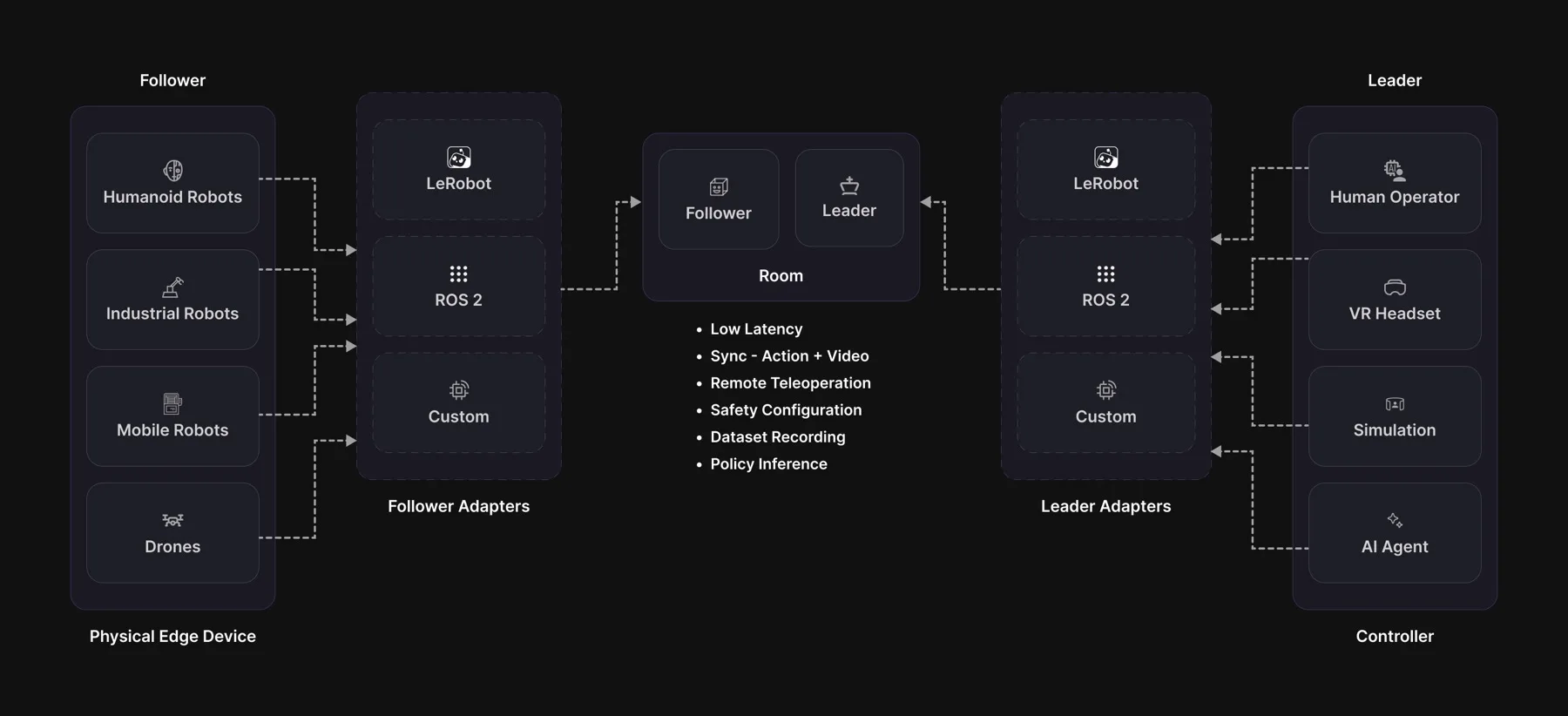 Torq ships as the `zeroruntime-teleops` Python package.
One side runs on the robot, the other wherever the operator is. Both join the
same room: the robot streams what its cameras see, the operator streams
how it should move. Every command is checked against limits you set before it
reaches the motors, and the session is recorded, on the robot or in the cloud,
as a dataset for training and evaluating policies.
`Follower` runs on the robot and `Leader` on the controller. Extend either one
to add your own hardware and behaviour. The SDK manages transport, safety,
correlation, sync and recording.
You do not need a robot to start. The
[Quickstart](/robotics/python/quickstart) runs the whole chain on a laptop, with a
dictionary standing in for the hardware. It does join a room, so you still
need a token.
## Use cases
Drive a robot from another room or another country, with low latency, your
own safety configuration, and automatic dataset collection.
Record while a person drives, then export a LeRobot dataset. Every action is
paired with the camera frame that caused it.
Neither side has to be real hardware. Drive a simulated robot, or let a
model send the movements instead of a person.
Let a model drive, and have a person take over whenever they need to.
## Roles
A session has exactly two roles. They can run on different machines, operating
systems or continents.
| Role | What it does | Can be |
| - | - | - |
| **Follower** | moves, and owns the cameras, the safety checks and the recording | a robotic arm, a humanoid, a mobile base, a drone, a simulated machine |
| **Leader** | produces the motion and asks for control | a person on a leader arm, a VR headset, a simulation, an AI agent |
The follower is in charge. It grants control, decides what is safe to apply, and
keeps the record. The leader asks for control and streams the motion it wants.
## Concepts
What happens between a command arriving and the robot moving.
The checks a command passes before it reaches the motors.
How video and joint readings are matched to the same moment.
What gets saved during a session, and how to export it.
## Build
Run the full chain with no hardware, then move to an arm.
Install the extras your role needs.
Every class, method and event, with defaults and examples.
## Integrate
Pick the path that matches the hardware you already have.
Drive an SO-101 through the LeRobot robot and teleoperator you already
use.
Connect any ROS 2 robot with joint topics. Torq currently ships one bridge
node that runs beside your own drivers, one per host.
Connect a custom robot or edge device by extending the Follower and
Leader classes.
## Need Help?
Join the community and connect with other developers.
Ask questions, report issues, and contribute feedback.
Book a demo, contact support, or speak with our sales team.
This documentation is built and hosted on [Mintlify](https://mintlify.com), a developer documentation platform.
Torq ships as the `zeroruntime-teleops` Python package.
One side runs on the robot, the other wherever the operator is. Both join the
same room: the robot streams what its cameras see, the operator streams
how it should move. Every command is checked against limits you set before it
reaches the motors, and the session is recorded, on the robot or in the cloud,
as a dataset for training and evaluating policies.
`Follower` runs on the robot and `Leader` on the controller. Extend either one
to add your own hardware and behaviour. The SDK manages transport, safety,
correlation, sync and recording.
You do not need a robot to start. The
[Quickstart](/robotics/python/quickstart) runs the whole chain on a laptop, with a
dictionary standing in for the hardware. It does join a room, so you still
need a token.
## Use cases
Drive a robot from another room or another country, with low latency, your
own safety configuration, and automatic dataset collection.
Record while a person drives, then export a LeRobot dataset. Every action is
paired with the camera frame that caused it.
Neither side has to be real hardware. Drive a simulated robot, or let a
model send the movements instead of a person.
Let a model drive, and have a person take over whenever they need to.
## Roles
A session has exactly two roles. They can run on different machines, operating
systems or continents.
| Role | What it does | Can be |
| - | - | - |
| **Follower** | moves, and owns the cameras, the safety checks and the recording | a robotic arm, a humanoid, a mobile base, a drone, a simulated machine |
| **Leader** | produces the motion and asks for control | a person on a leader arm, a VR headset, a simulation, an AI agent |
The follower is in charge. It grants control, decides what is safe to apply, and
keeps the record. The leader asks for control and streams the motion it wants.
## Concepts
What happens between a command arriving and the robot moving.
The checks a command passes before it reaches the motors.
How video and joint readings are matched to the same moment.
What gets saved during a session, and how to export it.
## Build
Run the full chain with no hardware, then move to an arm.
Install the extras your role needs.
Every class, method and event, with defaults and examples.
## Integrate
Pick the path that matches the hardware you already have.
Drive an SO-101 through the LeRobot robot and teleoperator you already
use.
Connect any ROS 2 robot with joint topics. Torq currently ships one bridge
node that runs beside your own drivers, one per host.
Connect a custom robot or edge device by extending the Follower and
Leader classes.
## Need Help?
Join the community and connect with other developers.
Ask questions, report issues, and contribute feedback.
Book a demo, contact support, or speak with our sales team.
This documentation is built and hosted on [Mintlify](https://mintlify.com), a developer documentation platform.